
A parent reviewing a referral for a child's crowded smile may hear that metal braces look old-fashioned, while another family points to clear trays. The practical choice depends on the tooth movements needed: metal braces are an adjustable force system, and fixed braces may work better for complex bite issues, severe crowding, or detailed tooth rotations.
Traditional metal braces use brackets, an archwire, and ligatures to guide teeth gradually. Most braces cases finish in 18 to 30 months. For Delaware families paying privately after Medicaid pre-authorization is denied, traditional metal braces typically cost $3,000 to $6,500.
Table of Contents
- What Metal Braces Are and Their Three Core Parts
- How Metal Braces Move Teeth Over Time
- How Metal Became the Standard for Braces
- Benefits and Drawbacks of Metal Braces
- Metal Braces Compared With Ceramic Braces and Invisalign
- Caring for Metal Braces Every Day
- Confirm Metal Braces Fit Before You Book a Consultation
What Metal Braces Are and Their Three Core Parts
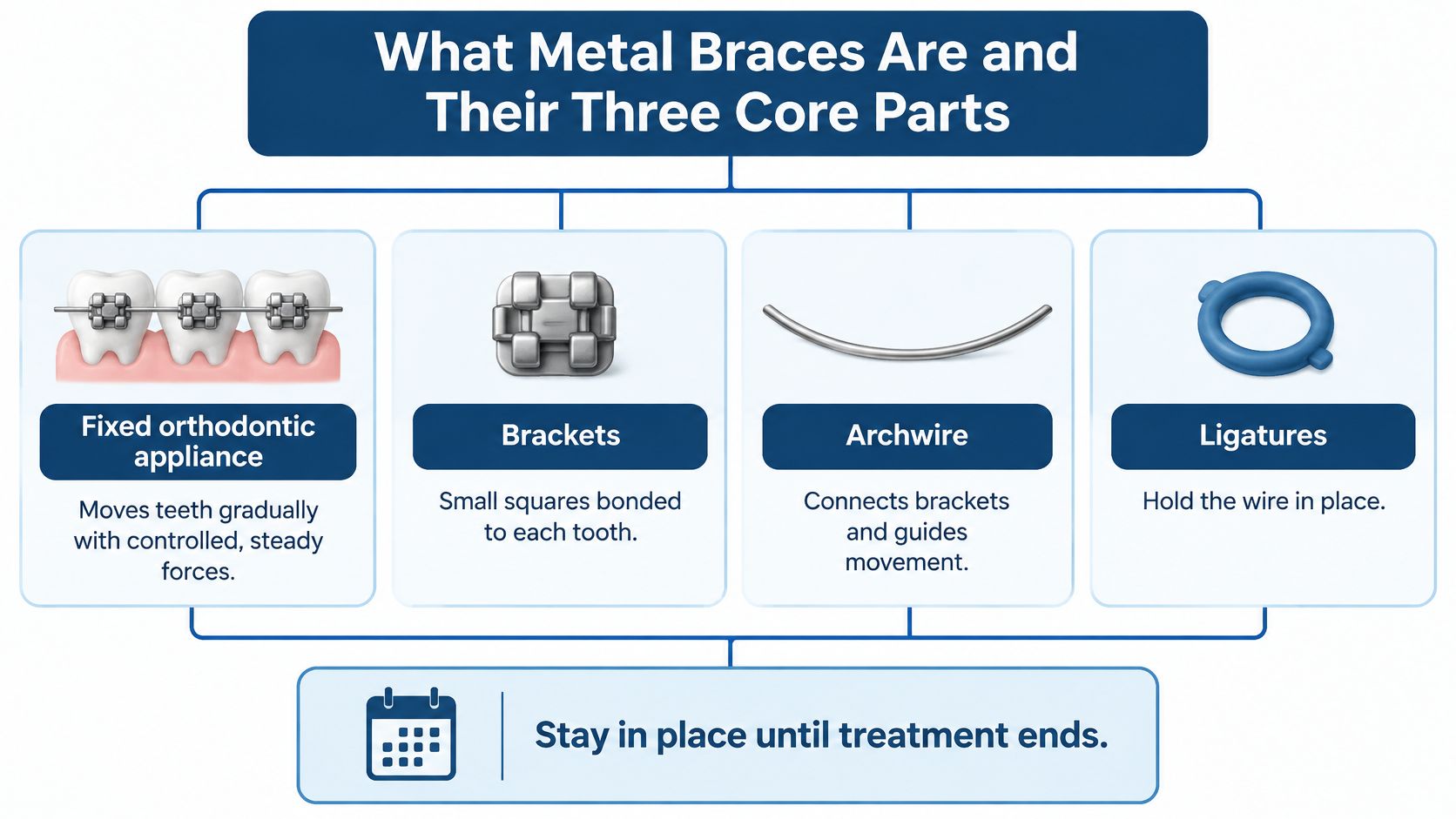
A bracket shifts slightly out of place, or a wire needs a different bend. Metal braces let an orthodontist adjust how force reaches individual teeth as treatment progresses. The system has three main parts: brackets, an archwire, and ligatures.
Brackets are small metal blocks bonded to the front of each tooth. They hold the wire and transfer its force to the tooth. Their position matters: each bracket helps guide its tooth along the intended path.
The archwire runs through the brackets. It supplies steady, adjustable force that gets updated at each visit. The brackets work like handles fixed to a drawer, while the wire guides their movement.
Ligatures hold the wire inside each bracket. They may be small elastic rings, slim metal ties, or built-in bracket doors. Colorful elastics are easy to notice, but their job is to keep the wire seated so its force reaches the teeth.
How the three parts share the job
| Part | What it does | Everyday picture |
|---|---|---|
| Brackets | Bonded to the front of each tooth and transmit force to it | Handles fixed to a drawer |
| Archwire | Runs through every bracket and supplies steady, adjustable force | A guide that moves the handles along a path |
| Ligatures | Hold the wire inside each bracket | Small elastic rings, metal ties, or built-in doors |
Some patients also wear elastic bands that hook onto selected brackets. These add force in a chosen direction to help correct the bite as well as tooth alignment.
Practical rule: A stronger wire cannot correct a bracket placed on the wrong path. Bracket position and wire shape work together to guide movement.
The standard bracket slot and archwire arrangement grew from designs developed by Edward H. Angle. Later, improved adhesives made it possible to bond brackets directly to teeth rather than wrap a band around each one. The system's practical advantage is adjustability: the orthodontist can change the wire and how it engages the brackets to guide specific tooth movements.
How Metal Braces Move Teeth Over Time
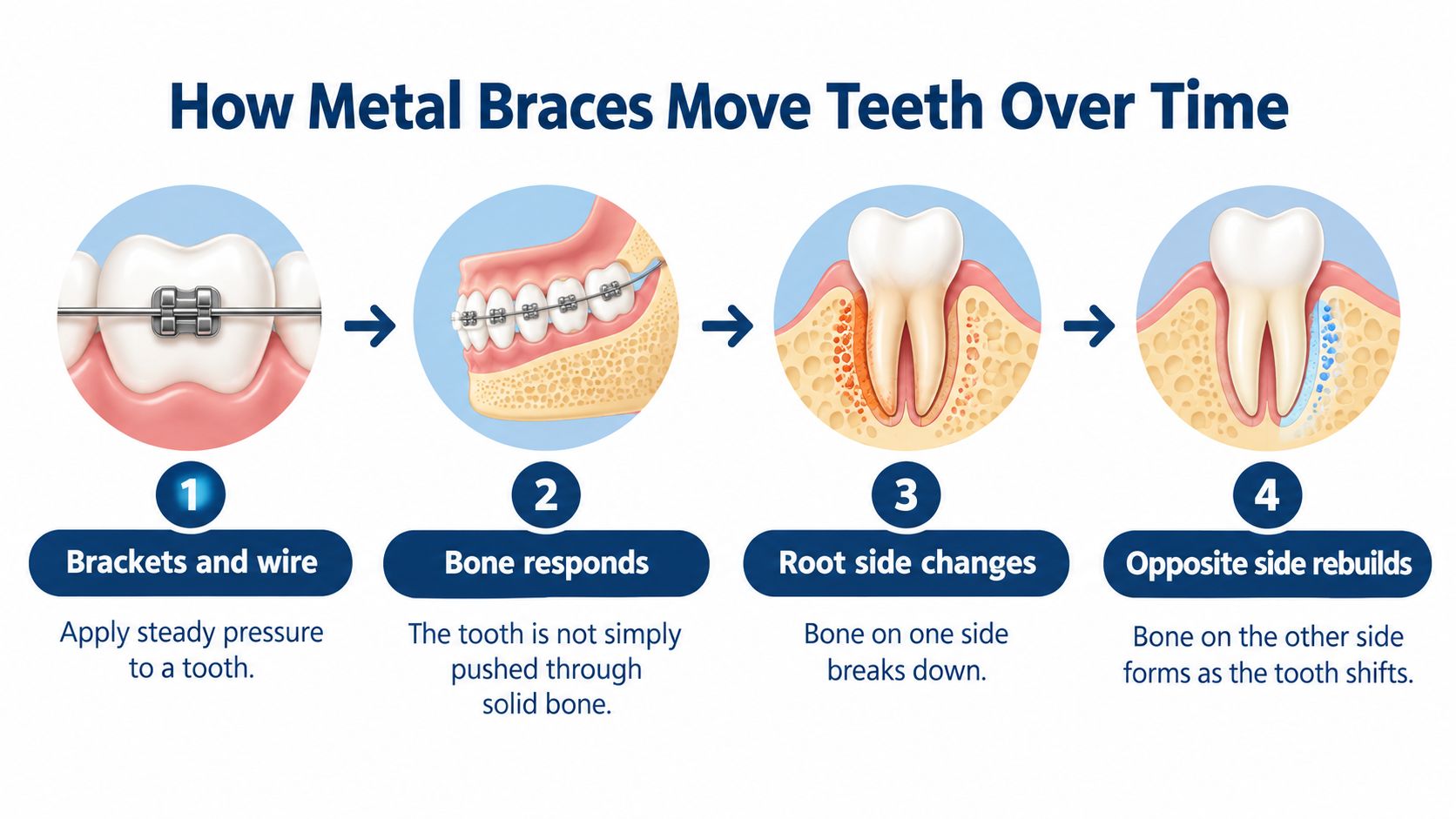
When a child's teeth begin responding to braces, the change happens gradually beneath the gums. The archwire applies pressure through the brackets, and the body remodels the bone around each tooth. The American Association of Orthodontists explains how braces use this bone-remodeling process.
The sequence a parent can picture
- Force goes on. Brackets and the archwire apply steady pressure to a tooth.
- One side compresses. The body removes bone on the side of the root facing the pressure.
- The far side is in tension. New bone forms on the opposite side.
- The tooth shifts. It moves gradually into the space created by this remodeling.
- The wire is adjusted. As teeth change position, the orthodontist adjusts the force and its direction.
Metal braces work as an adjustable force system. The orthodontist can change the wire's shape and make adjustments as the teeth respond, which helps guide demanding movements, including detailed rotations or bite changes. For more on bite correction, read how braces can fix jaw alignment.
What the treatment calendar looks like
Braces placement is a 60 to 90 minute appointment. Brackets are bonded to the front of each tooth, then the first archwire is placed. The appointment involves no injections or drilling, and the procedure itself is not painful. Soreness may develop later as the teeth respond to pressure, then settle as the mouth adjusts.
Most braces cases finish in 18 to 30 months. Simpler alignment may take less time, while cases involving rotation, space closure, or jaw coordination may take longer. At adjustment visits, the orthodontist checks the teeth's response and changes the wire as needed. Keeping those scheduled visits helps maintain useful, well-directed force throughout treatment.
How Metal Became the Standard for Braces
A bracket and wire system made fixed braces more repeatable. Earlier appliances often used bands wrapped around individual teeth, which made them bulky. Dental adhesives later allowed brackets to be bonded directly to enamel, making smaller appliances possible.
Edward H. Angle helped turn individually designed appliances into more standardized systems in the late 1800s and early 1900s. The designs evolved over time, but the broader shift was toward parts that could be produced consistently and used to guide tooth movement.
| Year | Milestone | Why it mattered |
|---|---|---|
| 1931 | Stainless steel introduced in orthodontics | Made appliances more affordable |
| 1960s | Stainless steel used in place of gold for archwires | Reduced the cost and size of fixed appliances |
From gold hardware to stainless steel
Early appliances often used gold or silver. These metals could be shaped and resisted rust in the mouth, but they were costly and difficult to make into small, stiff parts.
The British Orthodontic Society's history of fixed appliances marks 1931 as the point when stainless steel entered appliance construction and made braces more affordable. Steel was stiffer than gold, resisted corrosion, and could be made into smaller brackets and wires. By the 1960s, stainless steel was being used for orthodontic archwires in place of gold.
Lower-cost steel parts helped make fixed treatment more accessible to families. They also suited a system built around brackets and wires: the bracket holds the wire, and the wire applies force that can be adjusted as treatment progresses.
Benefits and Drawbacks of Metal Braces
When a tooth needs a carefully controlled movement, the bracket and wire work together like an adjustable guide rail. Metal braces offer a durable fixed system, which can make them a practical choice for demanding movements. Appearance, cleaning, and comfort are trade-offs to consider.
Where metal earns its place
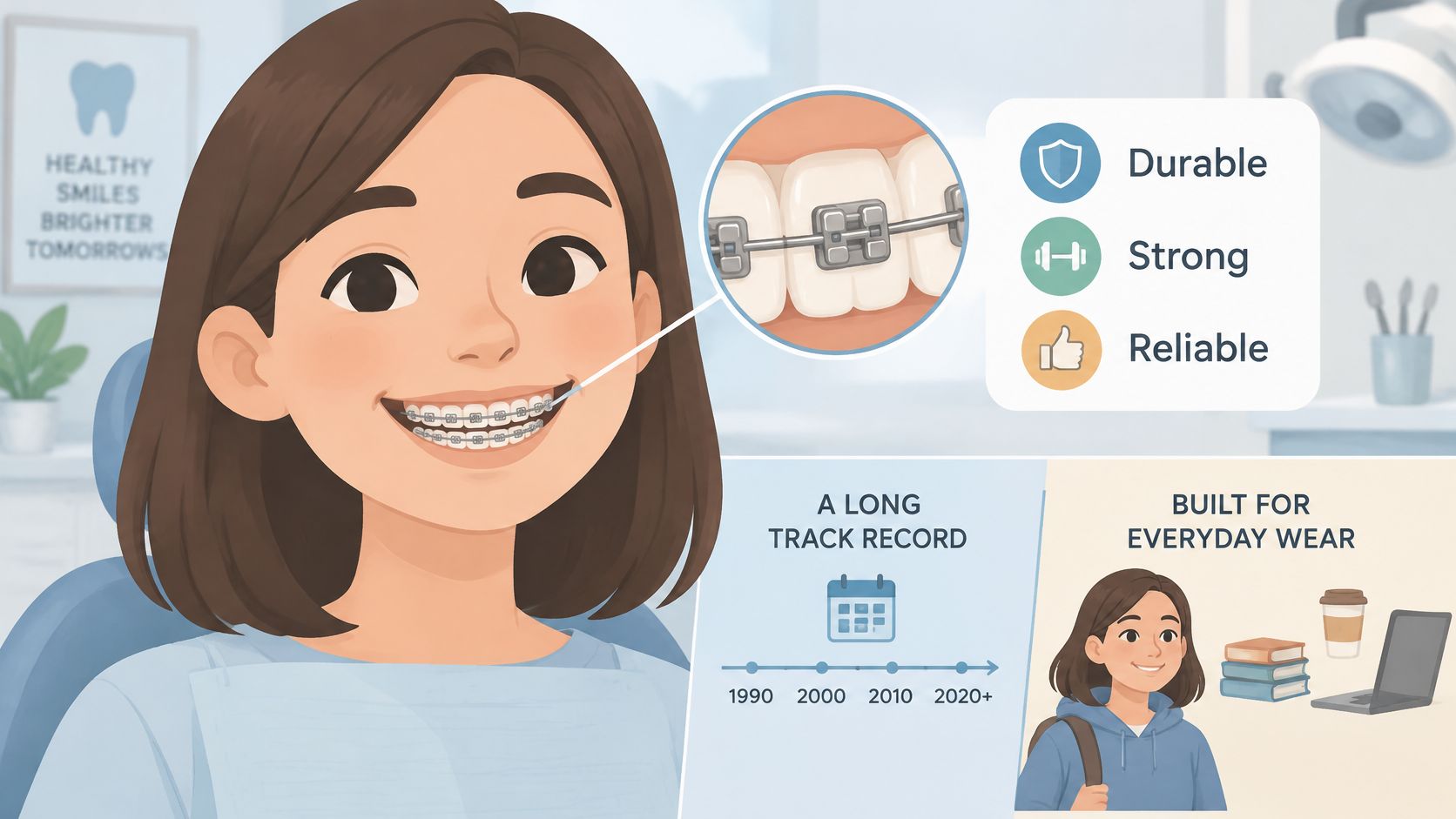
- Durability and strength: A 2025 review of orthodontic brackets highlights metal brackets' durability, strength, and reliability. It also describes newer 3D-printed metal brackets made with micro-laser sintering that may be lighter while retaining high strength. In everyday terms, the brackets are designed to stay attached and hold their shape.
- Control during movement: The bracket slot guides the wire. If a bracket flexes away from the wire, it can reduce how directly the wire controls the tooth.
- Low friction in sliding: A review of orthodontic materials reports that stainless-steel brackets paired with stainless-steel archwires generally produce the lowest friction among commonly evaluated combinations. Less friction means less force is lost as the wire slides through the bracket slot. For example, when braces are closing a gap after a tooth has been moved, the wire needs to slide along the brackets; lower friction can help that sliding movement proceed more efficiently.
The trade-offs to say out loud
- They are visible. Colored ties can add a personal touch, but the brackets remain noticeable.
- Food and plaque collect around the hardware. Brushing and flossing take more care than with teeth alone.
- Wires can poke, and brackets can come loose. Both may need attention at the orthodontic office rather than a home repair.
- Root shortening is a possible risk, not a certainty. An overview of systematic reviews reports more frequent orthodontically induced inflammatory root resorption with fixed appliances, especially alongside heavy force, intrusive or torqueing movements, longer treatment, extraction-based mechanics, or substantial movement of the root tip, particularly on upper front teeth. It also notes that cause and effect for each specific mechanic are not fully established.
The choice comes down to the patient's priorities: appearance, cleaning demands, durability, and treatment needs. A teen who removes clear aligners often may find a fixed appliance easier to keep in place. For contact sports, Stellar fits custom orthodontic mouthguards for its braces patients.
Metal Braces Compared With Ceramic Braces and Invisalign
A parent choosing braces for a teen may be weighing three things at once: how noticeable the appliance will be, what it can treat, and how it fits the budget. Metal braces work like an adjustable force system: the orthodontist can guide tooth movement through the brackets and wire, which can make fixed braces a practical choice for demanding movements. Ceramic braces and Invisalign offer different trade-offs.
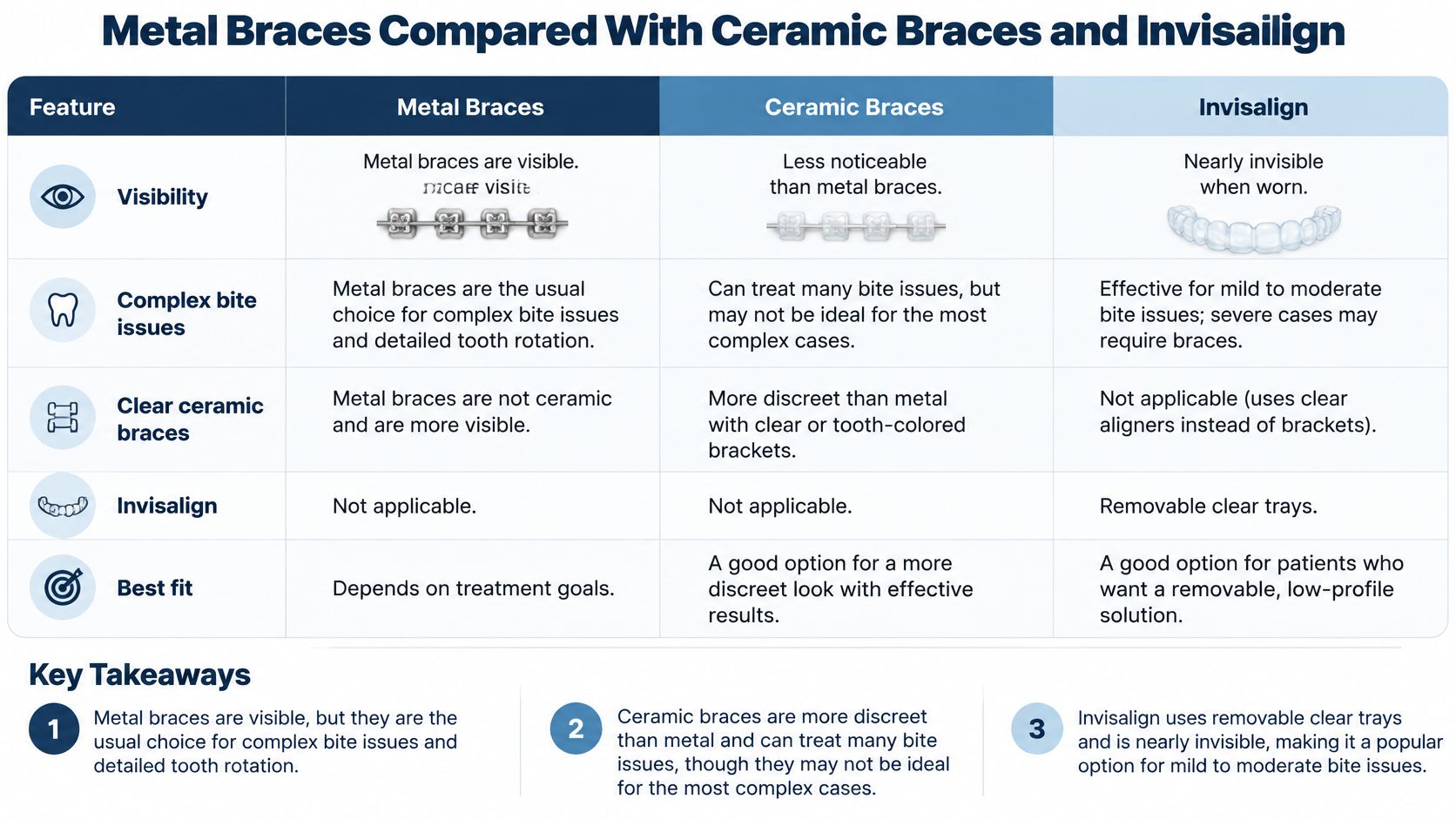
| Criterion | Metal braces | Clear ceramic braces | Invisalign aligners |
|---|---|---|---|
| Appearance | Visible metal brackets and wire | Tooth-colored brackets with a lower-profile look | Clear, removable trays |
| Typical cost | In Delaware, typically $3,000 to $6,500 for traditional metal braces when private pay applies after Medicaid pre-authorization is denied | Private-pay upgrade when Medicaid is the payer in Delaware | Cost depends on the treatment plan |
| Works best for | Complex bite issues, severe crowding, or detailed tooth rotation | Patients who want a fixed option with a lower-profile look | Mild to moderate cases, including many adults |
| Removable by the patient | No | No | Yes |
| Daily wear requirement | Fixed, no daily wear needed | Fixed, no daily wear needed | Wear as directed by the orthodontist |
Reading each row without the sales language
Appearance. Metal brackets and wires are visible. Ceramic braces use tooth-colored brackets and have a lower-profile look than traditional metal brackets. Invisalign uses clear trays that can be removed. Each option has a different appearance in daily life.
Cost. The cost of treatment depends on the option, coverage, and payment arrangement. In Delaware, traditional metal braces typically cost $3,000 to $6,500 if Medicaid pre-authorization is denied and the patient chooses private pay. Medicaid generally does not cover clear ceramic braces, which are an upgrade paid privately. Stellar Orthodontics offers monthly payment plans for braces and Invisalign.
Treatment fit. Traditional braces can treat simple and complex bite issues. Fixed braces may respond better to complex bite problems, severe crowding, or cases requiring detailed tooth rotation. Ceramic and traditional braces are equally effective when either is suitable for the case. The choice then depends on the patient's priorities for appearance and budget. For a closer comparison of the fixed options, read about ceramic braces compared with metal braces.
Invisalign is a discreet, removable option for teens and adults. Clear aligners work for most mild to moderate cases, including many adults, and suit patients who want flexibility without compromising results. Because trays come out for meals and brushing, the wearer needs to follow the orthodontist's directions for daily use.
A practical way to choose. Metal braces may be the more practical fixed option when treatment calls for demanding tooth movements. Ceramic braces offer a lower-profile look while remaining fixed, and Invisalign offers removability for suitable cases. The orthodontist can assess the bite and explain which options fit the treatment needs and the patient's priorities.
Caring for Metal Braces Every Day
Plaque control around the brackets is the habit that protects the result. The wire is doing its job even while your child sleeps. Food and bacteria are doing theirs too, unless someone cleans the spots the brush used to miss.
Daily habits that actually matter
- Brush after meals and before bed. Angle the bristles at the gumline and around each bracket, not only across the front of the tooth. A soft brush is enough. Scrubbing harder doesn't reach under the wire.
- Clean under the archwire once a day. A floss threader, an orthodontic flosser, or a small interdental brush gets the sides of the teeth the toothbrush skips. Water flossers help some kids, but they don't replace threading under the wire.
- Change how hard food is eaten. Cut apples, carrots, and crusty bread into small bites. Bite into a whole apple with a bracket on a front tooth and that bracket can pop off.
- Skip sticky and very chewy foods. Caramel, taffy, and gum wrap the wire and pull on brackets. A single candy can mean a repair visit and a week of stalled movement on that tooth.
- Use a mouthguard for contact sports. Stellar Orthodontics fits a custom orthodontic mouthguard for any braces patient who plays contact sports. A boil-and-bite guard from a store often doesn't seat over brackets.
When something feels wrong
A wire end pokes the cheek. Dry the spot, press a small piece of orthodontic wax over the end, and call the office. Wax is a cushion, not a fix, but it gets a child through the evening.
A bracket comes loose. Leave the wire in place if it isn't stabbing anything. Save the bracket if it falls off. Call to book a repair rather than waiting for the next adjustment, because that tooth has stopped receiving force.
Pain or swelling doesn't fade. Soreness for a few days after a wire change is common. Pain that keeps building, or gums that swell and bleed despite careful brushing, needs a call promptly.
Every adjustment visit is part of the force system. The orthodontist changes or reshapes the wire so movement stays on track. Families get instructions that fit the specific appliance, including which foods and which brush. A short, regular routine beats a perfect cleaning once a week.
Confirm Metal Braces Fit Before You Book a Consultation
For many Delaware families, understanding coverage and approval takes more planning than understanding the appliance itself. Medicaid or CHIP eligibility alone does not guarantee orthodontic coverage; approval depends on state rules and whether the bite problem meets the criteria.
An analysis of U.S. orthodontic expenditures found that children paid for much of their orthodontic care out of pocket during the study period, while children with public insurance accounted for a smaller share of orthodontist visits. A typical approval path includes an orthodontic evaluation, diagnostic records, prior authorization, and a provider who participates in the plan.
In Delaware, approved Medicaid coverage includes diagnostic records, traditional fixed metal braces, scheduled adjustments, repairs to broken brackets or wires, appliance removal, and the initial set of retainers. Ceramic braces are generally not covered and are an upgrade families pay for privately.
Three questions before you book
Which matters most: appearance, treatment flexibility, or budget? Traditional braces use metal brackets; clear ceramic braces use tooth-colored brackets and have a lower-profile look. Both are effective, so the choice depends on the patient's priorities and budget. Invisalign is a discreet, removable option for teens and adults who want flexibility.
What does the orthodontic evaluation show? The right appliance depends on the bite and the tooth movements needed. If you are unsure whether your child may need treatment, read how to know if your child needs braces.
Can your family attend the scheduled visits and manage the cost? Ask what the approval process requires, what Medicaid covers if authorization is granted, and whether a monthly payment plan would help if you choose private pay.
Stellar Orthodontics offers a free consultation and a free Medicaid braces evaluation at all four Delaware offices: North Wilmington, Middletown, West Dover, and Millsboro. The consultation is free whether or not treatment proceeds, insurance covers any of it, or a child qualifies for Medicaid braces.
Bring questions about the child's bite, coverage, and treatment options. A consultation can help clarify whether metal braces are the practical choice for the movements needed and the family's priorities.