
A parent opens last spring's family photo and stops on a teen's front teeth. One lower tooth twists behind its neighbor. The smile is still warm. The question is whether metal braces could line those teeth up, and what appointments, brushing, and school photos would ask of the family along the way.
That question is common. The American Association of Orthodontists' 2025 Economics of Orthodontics and Patient Census Survey, based on 2024 practice data, estimated approximately 6.42 million patients in active treatment among U.S. AAO member orthodontists, including about 3.77 million patients ages 8–17. Those figures cover braces and clear aligners together, so they aren't a metal-braces-only count. The same survey reported a median active-treatment duration of 22 months and a median appointment interval of six weeks for braces.
A metal braces smile starts as a bite or alignment problem, then shows up in pictures. Crowding, a gap, an overbite, a crossbite, an open bite, a shifted midline, or a mix of those issues each changes how teeth meet. The seven examples below say what was off, what fixed appliances tend to change, and which question helps at a consultation. Match the problem, not the lighting in someone else's photo.
Table of Contents
- 1. Crowding Correction Smile with Metal Braces
- 2. Gap Closure Smile (Spacing Between Front Teeth)
- 3. Overbite Correction Smile
- 4. Crossbite Correction Smile
- 5. Open Bite Improvement Smile
- 6. Midline Alignment Smile
- 7. Full-Smile Transformation with Metal Braces
- How each metal braces smile case compares
- Your Next Step: Seeing What Metal Braces Could Do for You
1. Crowding Correction Smile with Metal Braces
Say a 14-year-old's lower front teeth overlap so the toothbrush skips the twisted one. Crowding means there isn't enough room for every tooth to sit in a line, so teeth twist, overlap, or rotate. That matters for cleaning as much as for photos. Food packs into the overlaps, and the smile looks bunched even when chewing feels fine.
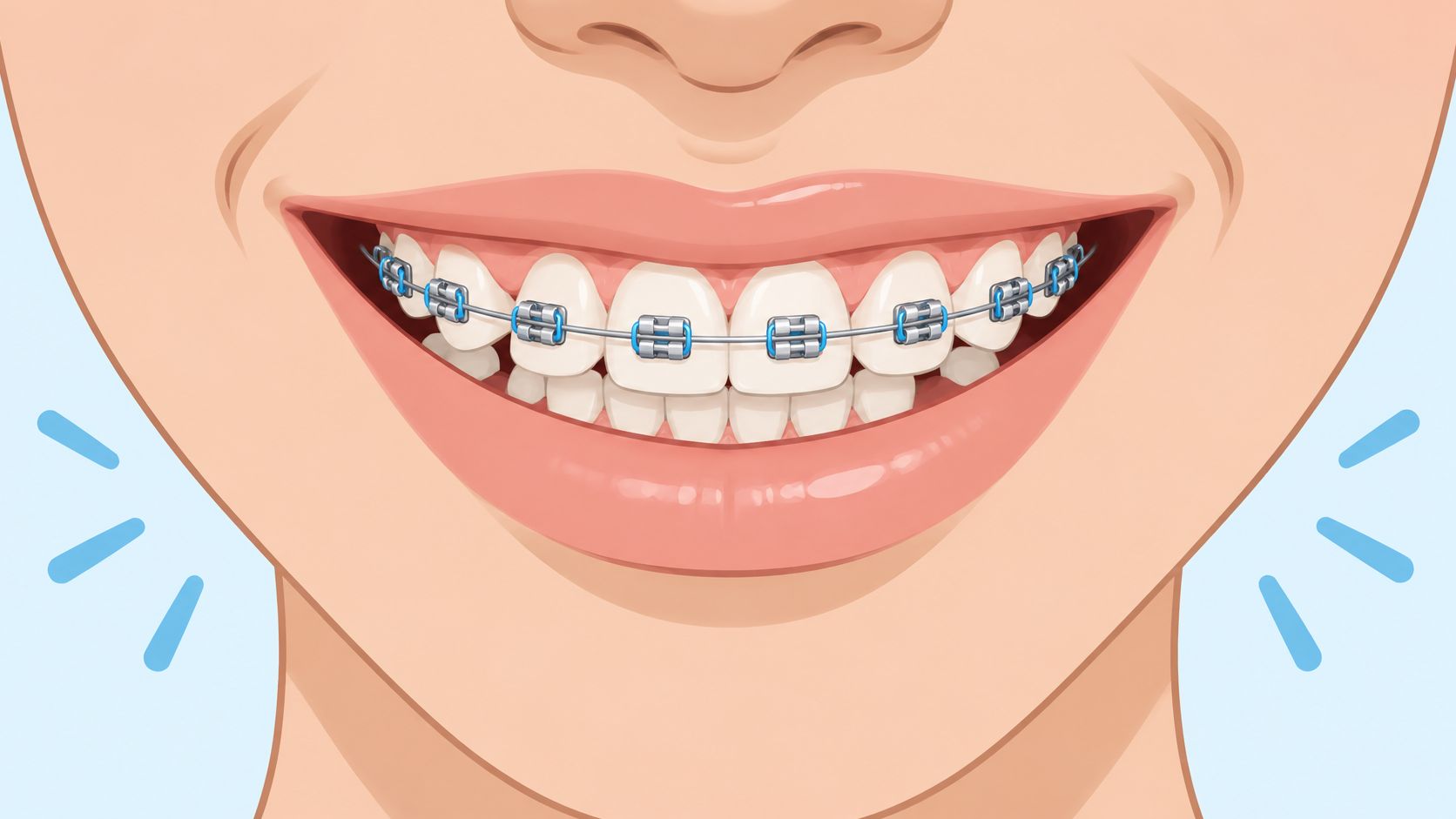
Metal braces bond a small bracket to each tooth and use a thin archwire to guide teeth into a better line. In a typical teen case, twisted lower incisors straighten across a series of adjustments until the edges sit side by side. An adult with mild crowding often follows a similar path, then moves to a retainer once the wire work is done. The orthodontist confirms whether braces alone make enough room.
What families should check in the photos
Before-and-after shots of crowding should show the same teeth, not just a wider grin.
- Overlaps gone: The twisted tooth sits beside its neighbors instead of hiding behind them.
- Enamel still even: The photo doesn't show obvious white scars around where brackets sat.
- A similar start: A severe pile-up isn't proof for a mild twist.
East Kent Hospitals' orthodontic treatment leaflet notes that poor brushing around brackets can damage enamel and leave permanent white or brown marks, and that treatment may be stopped early if cleaning stays unsafe. Brush after every meal. Ask to see crowding that started like this child, not an easier case. Families in Delaware can book a free consultation with iTero digital 3D scanning at Stellar Orthodontics in North Wilmington, Middletown, West Dover, or Millsboro.
2. Gap Closure Smile (Spacing Between Front Teeth)
A diastema is a space between two teeth, most often the upper front pair. In photos it appears as a dark line in the middle of the smile. For some children the space is waiting on adult teeth. For others the teeth never drifted together. The question is whether the gap is only a look or part of how the bite closes.
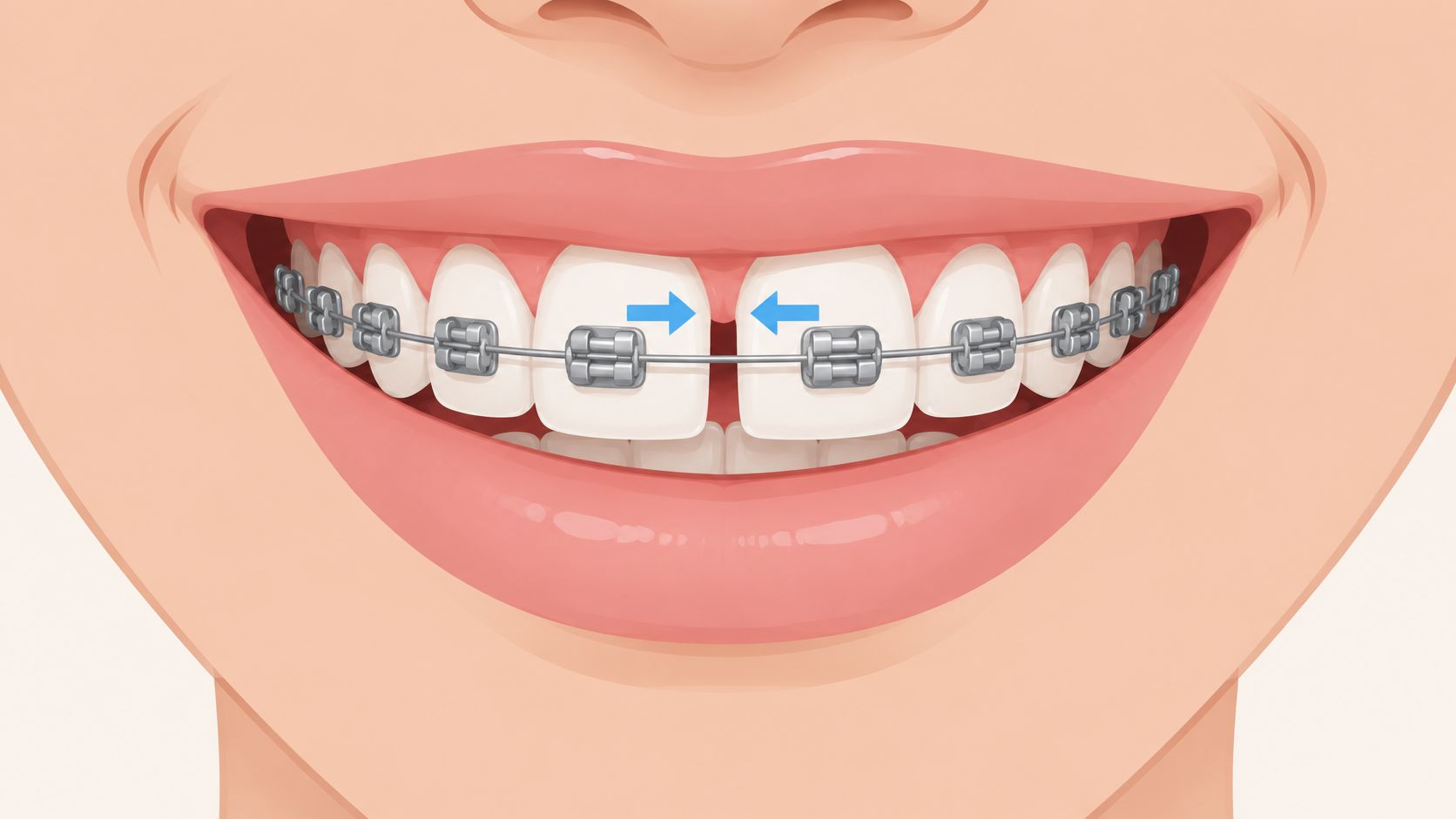
Metal braces can walk neighboring teeth toward each other with steady wire changes. A small space between upper front teeth often narrows until the edges meet. A child's gap may shrink as adult teeth settle and the wire finishes the job. Some spaces close with braces alone. Others need a retainer plan, or another step, once the cause is clear.
Keeping a closed gap closed
Practical rule: If thumb sucking or tongue thrusting helped open the space, say so at the exam. Braces can close a gap that a daily habit will reopen.
Fixed appliances stay on for meals and cleaning. Nottingham University Hospitals guidance on fixed appliances explains that a broken bracket or wire can stop the brace from working correctly, irritate the cheeks or gums, and extend treatment if it isn't repaired. Missed adjustments can stretch the calendar too. Wear retainers as directed after the space closes. Ask whether this gap is a tooth-position problem, a habit problem, or both.
3. Overbite Correction Smile
An overbite shows up when the upper front teeth sit well over the lower ones. In a closed-mouth photo the lower teeth nearly disappear. That overlap can wear edges, and it changes the profile people notice from the side. Metal braces don't only straighten the teeth that show in a grin. They change how the upper and lower teeth meet.
Elastics do the homework
A teen's plan often pairs brackets with elastics hooked on at home. After consistent wear, the front teeth look more even with the lips closed and with the smile open. An adult with the same deep overlap can see a similar bite change, though growth isn't helping the jaws anymore. Elastics only work when they're worn as instructed. Skipping days is the trade-off that stalls an otherwise solid plan.
A randomized clinical trial of 40 patients found root-length reduction of about 0.52 to 0.88 mm in the fixed-appliance group over six months, about 2.88% of original root length, and judged the change small. Appliance type alone didn't remove that risk. Ask how elastics, incisor movement, and root shape will be watched. More on the mechanics is in this explanation of how braces fix an overbite. For children, an early look can use growth instead of fighting it later.
Book that early visit if the upper teeth cover most of the lower ones when the child bites down.
4. Crossbite Correction Smile
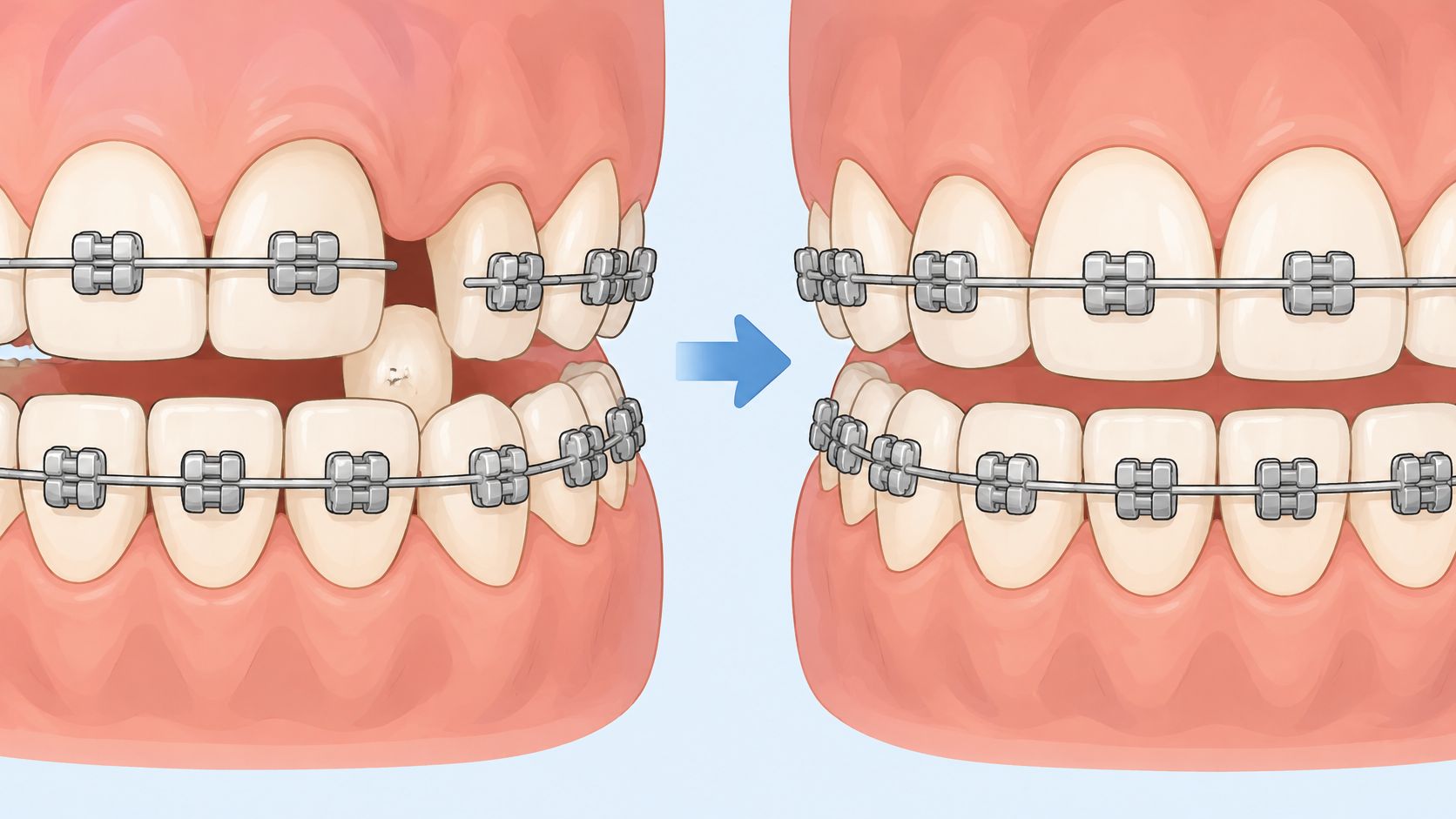
Some upper teeth sit inside the lower teeth when the mouth closes. That's a crossbite. It can be one front tooth tucked behind, or a whole back segment. Chewing feels off to one side, and a smile photo can look slanted even when the front teeth seem straight. The plan depends on whether the mismatch is in front, in back, or in both.
A bite that only shows when the teeth meet
A child's back teeth can be guided into a better relationship during early fixed-appliance treatment, before the crossbite becomes the comfortable way to chew. A teen's front tooth that hides behind the lower arch often needs a combined plan so the tooth moves out and the bite stops pushing it back in. What works is steady guidance while the new position is held. What doesn't work is judging the result from a wide smile that never shows the side teeth.
Bring a short list to the consultation.
- Which teeth cross: Front only, back only, or both sides.
- When it shows: Only on a full bite, or also in a relaxed smile.
- What the photo hides: Ask for a view with the teeth together, not just apart.
Tooth position and jaw position aren't the same job. This overview of how braces address jaw alignment is a useful primer before the visit. Ask for an early exam if a child's teeth don't meet evenly. Waiting can mean the crossbite has already trained the jaw to slide.
5. Open Bite Improvement Smile
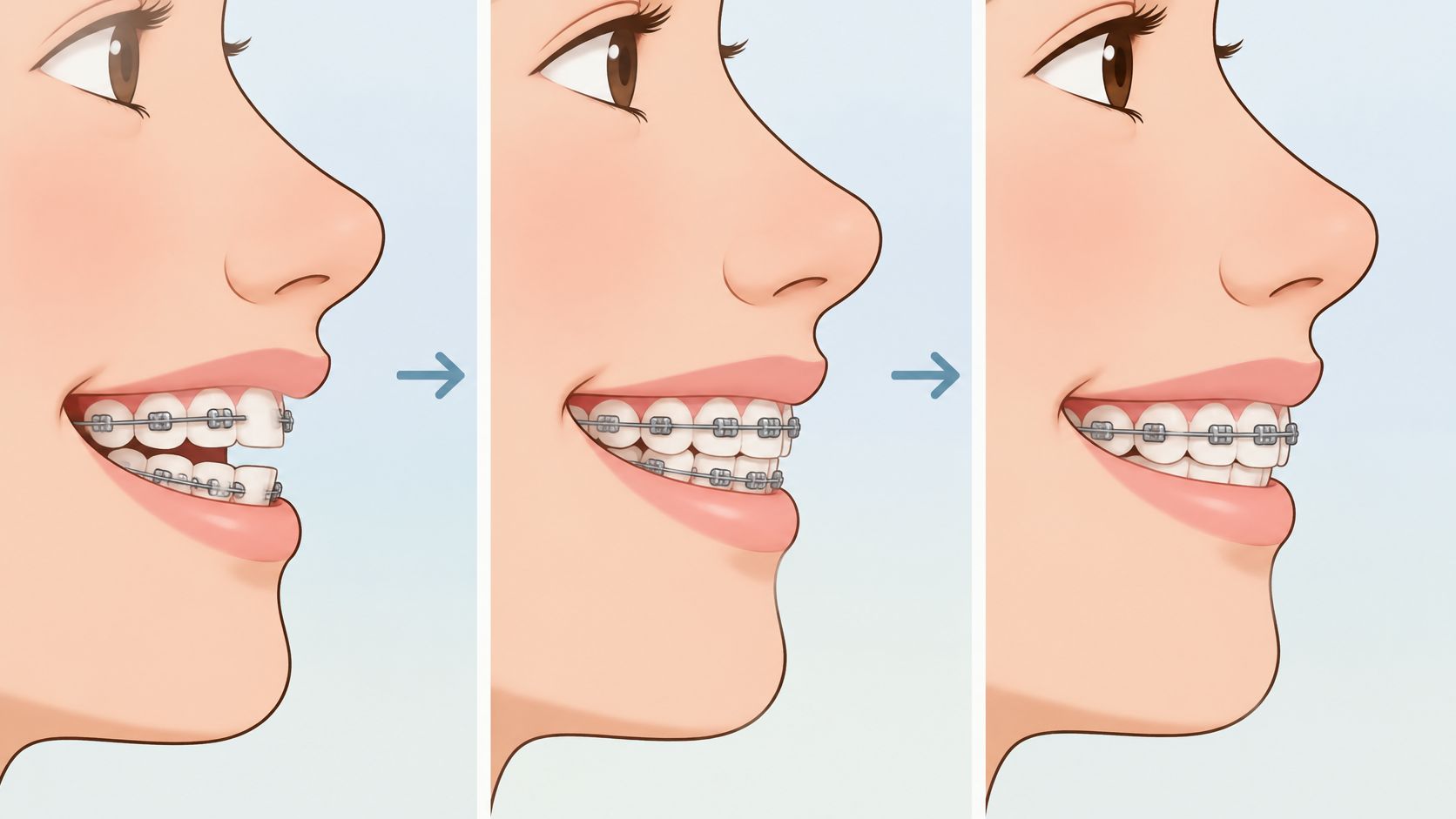
An open bite leaves a visible gap between the upper and lower front teeth when the back teeth meet. A child may push a straw or the tongue through the space. Biting into a sandwich can be awkward, and speech may sound less clear. In a resting smile, the gap can appear as a dark window.
Metal braces can move the front teeth closer together. For a child with a tongue-thrust habit, the treatment plan depends on whether that habit is still active: it may need to be addressed before braces can hold the front teeth together. For an adult, braces can close the visible space through tooth movement, without growth helping the correction. Ask at the consultation how the orthodontist will assess the habit and what needs to change before treatment begins.
The Frimley Health patient guide to fixed orthodontic appliances gives a typical treatment time of 18 months to 2 years, with more complex cases taking about 2.5 to 3 years. It also notes that teeth move about 1 millimeter per month and adjustments are commonly scheduled every 6 to 8 weeks. An open bite may take longer because closing the vertical space is a gradual process. Keep follow-up visits and discuss any ongoing thumb-sucking or tongue-thrust habit with the orthodontist.
When comparing before-and-after photos, check that the front teeth meet in the after image, not just that the smile looks more even. Ask whether the bite closes comfortably as well as looking improved.
6. Midline Alignment Smile
The midline is the imaginary line down the center of the face and between the front teeth. When it sits off to one side, a smile looks uneven even if each tooth is straight. Portraits show it faster than a bathroom mirror does.
Braces can shift teeth so that line sits closer to the middle of the face. In one teen example, upper and lower front teeth move toward center over several months while a small space closes, because the gap was what tugged the midline off. Check the finished photo against the nose and chin. A tilted camera can fake a win.
A straight row of teeth can still look crooked if the center of the smile misses the center of the face.
A 2025 systematic review of 30 studies found that children's oral-health-related quality of life commonly worsens during fixed-appliance treatment and improves afterward, and it covers separate adolescent research in which 98% wanted their teeth to look better and 70% were unhappy with their smile aesthetics. That review also found only low-quality evidence that treatment improves self-esteem, with conflicting results across age and gender. Older adolescents and those facing bullying carried a greater psychosocial burden in that adolescent research. Don't promise that a centered midline fixes confidence. Share symmetry worries at the consult, ask how a digital scan can preview the shift, and ask the child what they want changed.
7. Full-Smile Transformation with Metal Braces
A full-smile correction may need to address crowding, gaps, an uneven bite, and a shifted midline at the same time. Metal braces can guide several teeth as part of one coordinated plan. For example, a teen with overlapping teeth, a small space, and a bite that does not meet evenly may need all three concerns addressed together. An adult whose alignment concerns have accumulated over time may also need a plan that coordinates tooth position and bite.
The whole frame of the smile changes, not one tooth at a time. Growth stage and tooth-root shape can affect how treatment is planned and monitored, while each person's teeth respond differently. Compare before-and-after photos by checking which concerns were present at the start and what changed in the finish. A photo showing mild spacing alone cannot demonstrate how braces address crowding and a deep bite together. Ask at a consultation: which parts of my bite and smile would this plan change?
A randomized clinical trial involving 32 adults with Class I malocclusion and moderate crowding reported a mean treatment duration of 24.2 months. Median external apical root resorption was 0.72 mm with fixed appliances and 0.71 mm with clear aligners, with no statistically significant difference. Upper lateral incisors showed significantly greater resorption than other incisors in that sample. Root shape is one factor to discuss when reviewing monitoring and appliance choices.
Colored elastics can be changed at adjustment visits, offering a way to change the braces' appearance without changing the hardware. Review the types of metal braces before discussing which option fits the treatment plan. A short clinic video shows fixed braces on a smile.
- One calendar: Keep adjustment visits so coordinated tooth movements can continue as planned.
- Your treatment plan: At a free consultation, ask which bite, spacing, crowding, and midline concerns braces would address. Stellar Orthodontics offers consultations in North Wilmington, Middletown, West Dover, and Millsboro.
How each metal braces smile case compares
| Smile example | Treatment problem and what metal braces address | Typical treatment timeline | Consultation question |
|---|---|---|---|
| Crowding Correction Smile with Metal Braces | Overlapping or rotated teeth need room and guidance into a more aligned row. | Timing depends on the amount of movement needed. | How will the plan create space and align the rotated teeth? |
| Gap Closure Smile (Spacing Between Front Teeth) | A gap between the front teeth is closed by moving the teeth together. | Closure takes months, with timing based on the gap and bite. | What will keep the gap closed after treatment? |
| Overbite Correction Smile | Upper front teeth extend over the lower teeth, affecting how the bite fits together. | Timing depends on bite severity. | How will the plan change the overlap, not just the front teeth's appearance? |
| Crossbite Correction Smile | Upper teeth sit inside lower teeth when biting; braces guide them toward a better bite position. | Plan and timing depend on the case. | Which teeth need to move so the upper and lower teeth meet correctly? |
| Open Bite Improvement Smile | Front teeth do not touch when biting; braces work to bring them closer together. | About 18 to 24 months for some cases; more complex cases may take 2.5 to 3 years. | What factors could make closing the bite take longer? |
| Midline Alignment Smile | Front teeth sit off the facial center; braces shift them toward a more centered position. | Timing depends on the movements required. | Is the midline shift related to the bite, and what can braces correct? |
| Full-Smile Transformation with Metal Braces | Multiple concerns, such as crowding, spacing, bite, and midline, must be coordinated. | Often longer than simple alignment; the plan depends on the combined concerns. | Which bite and alignment changes should I look for in the finished photos? |
The open-bite example has the clearest stated range, while the other timelines depend on the movements and bite involved. When comparing photos, check whether the starting concern matches yours, whether the bite changed as well as tooth alignment, and what the treatment plan says about the finish.
Your Next Step: Seeing What Metal Braces Could Do for You
Start with the concern that most resembles your own smile, then ask what the example shows about the bite as well as the tooth positions. Crowding and crossbite involve different treatment problems, so one photo cannot predict another person's result or timing. Write down two or three questions before discussing examples.
Use a simple photo checklist. Check that the before photo shows the same teeth at the same angle. Look for a similar starting concern, and see whether the explanation names the bite issue or only describes straighter edges. Ask whether retainers, elastics, oral habits, or cleaning affect the plan. A useful comparison makes clear what changed and what follow-up may involve.
The FDA's consumer update on braces explains that traditional braces may use metal, plastic, or ceramic brackets, and that companies must meet applicable requirements for safety and effectiveness. It also gives an average orthodontic treatment period of about two years, although treatment can take more or less time. Treat that figure as a general planning reference, not a personal finish date.
Stellar Orthodontics offers traditional metal braces for children, teens, and adults at four offices: North Wilmington (2304 Concord Pike), Middletown (818 Kohl Avenue), West Dover (125-2 Greentree Drive), and Millsboro (26670 Centerview Drive). Free consultations include iTero digital 3D scanning, which helps the orthodontist plan around the individual teeth and bite rather than a gallery example.
Bring the photo that prompted your questions, along with notes about habits, sports, or any earlier dental injury. Ask what the braces would address, what trade-offs to expect, and how progress will be assessed. A scan and conversation can turn a general example into a plan based on your own smile.
Stellar Orthodontics offers free consultations with iTero digital 3D scanning at its four Delaware locations. Visit Stellar Orthodontics to book a consultation in North Wilmington, Middletown, West Dover, or Millsboro.